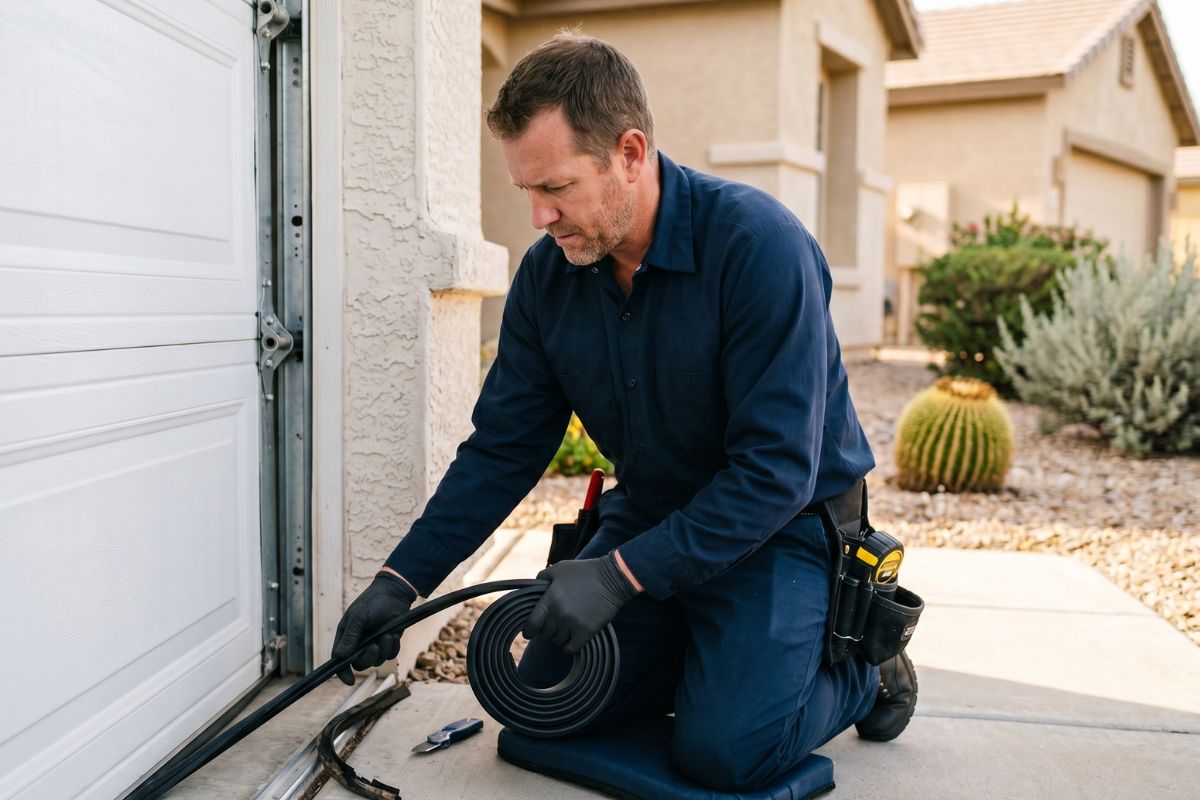
Garage door weatherstripping fails gradually — and most Mesa homeowners don’t notice until their energy bill spikes or desert dust coats everything inside the garage. The rubber seals, vinyl compression strips, and threshold gaskets that line your garage door opening degrade under Arizona’s extreme UV exposure and temperature swings. When those seals fail, warm air, cold drafts, scorpions, rodents, and fine particulate matter all get in through gaps you can’t always see. A properly sealed garage door holds a consistent interior temperature, protects stored vehicles and equipment, and reinforces the structural integrity of your home’s thermal envelope.
At Mesa Premier Locksmith & Garage Repair, we service garage doors and door hardware across the East Valley every day. We know exactly what Arizona’s climate does to weatherstripping — and we know which materials hold up and which ones fail within a season.
If you’ve been noticing light coming under your garage door, feeling a draft near the opening, or finding debris piled along the bottom seal, this guide walks you through what’s happening, what the right fix looks like, and when a professional replacement makes more sense than a weekend DIY project. You can also find us on Google Maps to see our location, verified reviews, and service area across Mesa and the surrounding East Valley cities.
We’ve spent years helping Mesa homeowners protect their garages from Arizona’s brutal seasonal shifts. Our certified technicians handle everything from garage door repair to full hardware replacement, and we bring the same attention to detail to weatherstripping that we apply to every other component we touch.
What Garage Door Weatherstripping Actually Does — and Why It Fails in Arizona
Garage door weatherstripping is the system of seals that lines the bottom, sides, and top of your garage door opening. It’s not a single product — it’s a multi-component system that includes the bottom seal (door sweep), side stop molding, top seal, and in some installations a floor threshold seal. Each component plays a different role in blocking air, water, dust, and pests from entering the garage.
In most U.S. climates, weatherstripping fails slowly due to friction and moisture. In Mesa and the greater East Valley, the failure mode is different. UV degradation is the primary culprit. Arizona’s solar radiation breaks down vinyl and rubber compounds at an accelerated rate — the same process that cracks dashboard covers and dries out rubber gaskets under your hood. Add to that the thermal cycling between 40°F winter nights and afternoon highs that push into the 70s and 80s during the day, and you have a material that expands and contracts repeatedly without ever getting a break.
The result: your bottom seal becomes brittle and pulls away from the door panel. Your side compression strips flatten and stop making consistent contact with the door frame. The top seal develops cracks. All of this happens on a two-to-three year cycle in the Valley, compared to the five-to-seven year lifespan weatherstripping sees in more temperate climates.
Our garage door service team inspects all four weatherstripping zones every time we visit a property — not just the obvious bottom seal.
Garage Door Weatherstripping: Types, Materials, and What Works in the Desert
Choosing the right weatherstripping material matters as much as the installation itself. The market offers several options, and not all of them are appropriate for Arizona’s conditions.
Bottom seals are the most visible and most frequently replaced component. They come in three primary configurations:
- T-slot rubber seals — These slide into a channel along the bottom of the door panel. They’re the most common OEM seal on LiftMaster, Chamberlain, and Genie doors. They’re easy to replace and hold up reasonably well in desert conditions.
- Nail-on vinyl seals — Attached directly to the door bottom, these are often used as retrofit solutions. Vinyl degrades faster than rubber under UV, so we rarely recommend them for Mesa homes as a long-term fix.
- Bulb seals — A rounded rubber seal that creates a compression fit against the floor. These work well on uneven concrete surfaces, which are common in older Mesa homes where the garage floor has settled or cracked.
Side and top seals are typically made from foam compression strips or rubber V-strips and are stapled or nailed to the door stop molding — the wood trim that lines the interior frame of the garage opening. In Arizona, foam compression strips lose their elasticity faster than rubber alternatives. When our technicians replace side seals, we typically recommend reinforced EPDM rubber strips, which handle thermal cycling significantly better than standard foam.
Threshold seals sit on the garage floor itself rather than on the door. They create a secondary barrier that works independently of the door’s bottom sweep. For Mesa homeowners dealing with monsoon season runoff or heavy dust intrusion, a threshold seal combined with a good bottom sweep provides substantially better protection than either component alone.
Our garage door hardware services cover all of these components. If you’re not sure which seal type your door uses, our technicians can assess it on-site and recommend the right replacement.
Quick Diagnosis: Weatherstripping Problems and What They Mean
Use this table to identify what’s failing before you call or attempt a repair:
| Symptom You Notice | Likely Cause | What a Pro Checks | DIY or Pro? |
|---|---|---|---|
| Light visible under the door on one side only | Door out of level — track or cable misalignment, not just seal failure | Track alignment, cable tension, torsion spring balance across both sides | Pro Only |
| Light visible under the entire door bottom | Bottom seal worn, cracked, or missing | Seal channel condition, door bottom straightness, floor levelness | DIY Possible |
| Dust or sand accumulating inside after windstorms | Side or top seal failure — compression strips flattened or cracked | Stop molding condition, seal contact consistency along full frame height | DIY Possible |
| Water entering during monsoon rain | Bottom seal gap + no threshold seal | Floor slope, threshold compatibility, bottom seal profile type | DIY Possible |
| Scorpions or rodents found inside the garage | Gap at bottom corners or side seal base | Full perimeter seal inspection, corner gap measurement, threshold fit | Inspect First |
| Opener reports “door ajar” despite door closed | Warped bottom seal or door misalignment triggering position sensor | Sensor alignment, door close limit, bottom seal warp, track squareness | Pro Only |
| Cold draft near garage on winter nights | Combined failure: bottom seal + side seals + uninsulated panels | Full weatherstripping audit + panel insulation value assessment | Assessment First |
How Weatherstripping Connects to Garage Door Safety and Performance
⚠️ Safety Notice: Garage door bottom seals and side stop molding are generally safe for homeowners to inspect and replace. However, if your weatherstripping issue is related to a misaligned door panel, a bent track, or a door that doesn’t sit level in the frame, do not attempt to adjust the torsion spring system yourself. Torsion springs operate under several hundred pounds of tension and can cause serious injury if disturbed without proper training and tools. Contact a licensed garage door technician for any repair that involves the spring system, cable drums, or track alignment.
A door that doesn’t seal correctly is often a door that doesn’t close correctly. The two problems are connected more often than homeowners realize.
Door alignment directly affects seal performance. If your door sits slightly out of square in the frame — a common result of track wear, cable stretch, or foundation settling — the bottom seal won’t make even contact with the floor across its full width. You’ll get a good seal at one corner and a visible gap at the other. No amount of bottom seal replacement will fix this until the door’s travel path is corrected.
We see this regularly in Mesa homes built in the 1990s and early 2000s, where the original single-layer steel doors have been replaced with heavier insulated models without a corresponding upgrade to the opener or the track system. The added door weight changes how the springs balance the door through its range of motion.
Our garage door opener repair and track adjustment services address the root cause — so that when we install new weatherstripping, it seals the way it’s supposed to.
Smart home integration and garage door sealing also intersect. Homeowners using LiftMaster 8500W or myQ-enabled openers may notice that their door position sensors flag alignment issues before the seal failure becomes visible. If your opener is reporting “door ajar” errors despite the door appearing closed, a warped bottom seal or misaligned door is often the cause.
Proper weatherstripping also contributes to home security. A garage door that doesn’t seal at the sides can be vulnerable to shimming — a technique where a thin flat tool is inserted through the side gap to release the emergency cord. A tight-fitting side stop seal reduces that gap and makes the door more resistant to this type of forced entry. Our residential locksmith services and garage door security work address this overlap directly.
DIY vs. Professional Weatherstripping: Knowing When to Call
Some weatherstripping replacements are genuinely straightforward. A T-slot bottom seal on a standard residential door is a task most mechanically comfortable homeowners can complete in under an hour with basic tools. The seal slides out of the channel, the new one slides in, and you trim the excess.
Other situations are more complex — and attempting them without the right experience leads to more damage.
Here’s how we’d break down the decision:
Appropriate for DIY:
- Replacing a T-slot bottom seal on a door that closes evenly and sits level
- Adding a door threshold seal to a concrete floor with no major cracks or slope
- Replacing foam compression strips on side stop molding when the door frame is in good condition
Call a professional when:
- The door has visible gaps on one side but not the other (alignment issue)
- The door panel itself is bent, dented, or warped
- The seal failure is accompanied by unusual door movement or noises during opening/closing
- You need to replace nail-on seals on a steel door without damaging the door’s weather coating
- The garage door opener is reporting errors related to door position
- Your door is connected to a security system or smart home platform and needs recalibration after adjustment
Our garage door repair technicians in Mesa are licensed, bonded, and insured, and we carry a full inventory of replacement seals for LiftMaster, Chamberlain, Genie, and most standard residential door configurations. We provide upfront pricing before any work begins — no estimates that change when we get on-site.
For homeowners considering a new garage door installation rather than a repair, we can assess whether your existing door and frame are worth sealing or whether a replacement is the better long-term investment.
Weatherstripping and Winter Energy Efficiency in Mesa Homes
Mesa’s winters are mild compared to the rest of the country, but they’re not trivial for garage-adjacent living spaces. When overnight temperatures drop into the low 40s — which happens regularly between December and February — an unsealed garage becomes a cold zone that affects any attached rooms, utility connections, or water lines running through the garage wall.
The energy efficiency case for garage door weatherstripping is straightforward. The U.S. Department of Energy notes that air sealing and insulation in attached garages can measurably reduce heating and cooling loads in the adjacent living area. A properly sealed garage door eliminates a major bypass in your home’s thermal envelope.
For Mesa homeowners with converted garage spaces, workshops, or HVAC equipment stored in the garage, the insulation value is even more direct. Our garage door insulation services include both weatherstripping replacement and panel insulation assessment — we evaluate the full system, not just the seal at the bottom.
We also work with homeowners on locksmith services for home security that extend to the garage — including reinforcing the door between the garage and living space, upgrading the lock on the side entry door, and ensuring the garage door opener system is secured against code-grabbing and relay attacks.
Frequently Asked Questions
Frequently Asked Questions
Honest answers from our Mesa garage door technicians — no filler, no upselling.
How often should garage door weatherstripping be replaced in Mesa, AZ?
In the East Valley, we recommend inspecting your weatherstripping every 18 to 24 months due to Arizona’s UV intensity and thermal cycling. Most rubber bottom seals and foam compression strips need replacement every two to three years — roughly half the lifespan you’d see in a cooler climate. A quick visual check for cracking, flattening, or visible gaps tells you when it’s time.
How much does garage door weatherstripping replacement cost?
Bottom seal replacement on a standard single or double car garage door typically ranges from $80 to $180 for parts and labor, depending on door width and seal type. Full perimeter replacement runs higher. We provide upfront pricing before starting any work. Contact our Mesa team for a specific quote.
Can I replace the garage door bottom seal myself?
If your door uses a T-slot channel — standard on most LiftMaster, Chamberlain, and Genie doors — the bottom seal slides out and the replacement slides in. It’s manageable as a DIY task if the door closes evenly and the channel isn’t corroded. If you’re seeing a gap on one side only, that’s an alignment issue that needs professional attention first.
What’s the difference between a bottom seal and a threshold seal?
A bottom seal attaches to the door itself and moves with it — pressing against the floor when the door closes. A threshold seal bonds to the garage floor and creates a secondary barrier the door closes against. For monsoon season protection and pest control in Mesa homes, using both components together provides significantly better coverage than either one alone.
Does weatherstripping affect garage door security?
Yes — a loose or missing side seal creates a gap that can be used to reach the emergency release cord, disengaging the opener and allowing the door to be opened manually. Tight-fitting side seals reduce that gap. Our residential security team can assess this as part of a broader garage entry review.
Will new weatherstripping help with my energy bills?
For attached garages or converted spaces, yes — measurably. An unsealed garage door creates a direct air exchange with the outdoors that affects adjacent rooms and any HVAC equipment stored in the garage. We recommend pairing new seals with a panel insulation assessment through our garage door repair service.
My door closes but still feels drafty — what else could cause this?
A door that appears closed but still drafts usually has one of three issues: panel gaps from door warping, a worn top seal that’s lost compression against the header, or side seals that have flattened enough to leave small consistent gaps. Our technicians inspect all four seal zones — not just the bottom — to find the actual source.
Do you service garage door weatherstripping in Gilbert, Chandler, and Tempe?
Yes. Our service area covers Mesa, Gilbert, Chandler, Tempe, Scottsdale, and surrounding East Valley communities. We dispatch mobile technicians with parts on board for same-day service on most standard residential configurations. Reach out through our contact page to schedule.
Putting It All Together
Weatherstripping is the part of your garage door system that gets ignored until it fails completely — and by the time most homeowners notice the gap, the damage to the seal has been building for a full season or more. The fix itself is straightforward when the door is properly aligned and the frame is in good condition. The challenge is knowing whether you’re dealing with a seal problem or a door problem.
At Mesa Premier Locksmith & Garage Repair, our certified technicians assess the full system — alignment, seal condition, opener calibration, and panel integrity — before recommending any repair. That approach keeps us from replacing a bottom seal on a door that needs a track adjustment, which would just result in the same gap and the same call six months later.
We’ve built a strong reputation across Mesa and the East Valley for honest diagnostics and transparent pricing. Our customers can verify that directly through our Google Business profile, where we maintain a consistent review record across hundreds of residential and commercial service calls.
If you’re dealing with a draft, a pest entry point, or a door that just doesn’t seem to close right, call us at the number on our contact page or visit our services overview to see the full range of what our technicians handle. For a deeper look at how garage door systems interact with your home’s overall security, take a look at our related post on garage door opener safety and security.
Mesa Premier Locksmith & Garage Repair LLC — licensed, bonded, and insured — serving Mesa, Gilbert, Chandler, Tempe, Scottsdale, and the surrounding East Valley. Call us, visit our listing, and let’s get your garage sealed right.