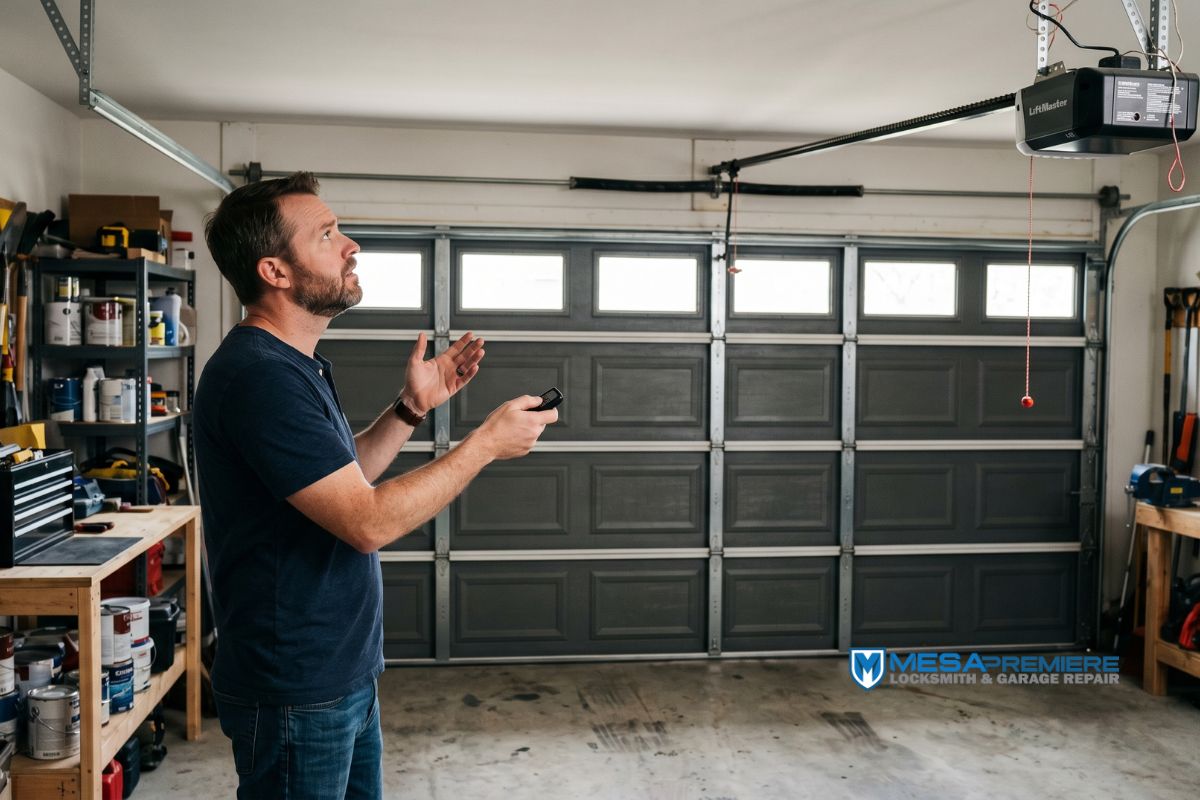
You press the button from the driveway, the porch light flickers, and the door just sits there. The frustration is real — especially when you’re running late, groceries are melting in the trunk, or a storm is rolling in over the Superstition Mountains. The good news is that a dead garage door remote almost always traces back to one of four predictable issues, and most are fixable in under ten minutes. Keep reading — we’ll walk you through the exact diagnostic path our technicians use every day across Mesa and the East Valley, so you can tell in minutes whether this is a five-dollar fix or a sign your opener needs professional attention.
Garage Door Remote Troubleshooting: Where to Start
Before tearing into the motor unit or pricing a replacement, run a fast triage. At Mesa Premier Locksmith & Garage Repair LLC, we’ve handled thousands of failed remotes, and the root cause lands in one of four buckets more than 90% of the time: the battery, the remote’s circuit board, the opener’s receiver, or the programming link between them. Working through those in order saves time, money, and guesswork — and it’s the same sequence we teach our own technicians during in-house training.
| Remote Symptom | Most Likely Cause | First Fix to Try |
|---|---|---|
| No response at all | Dead CR2032 battery | Replace battery; check polarity |
| Works only near door | Weak battery or LED bulb interference | Swap battery; replace LED bulbs with incandescent |
| Motor hums, door reverses | Misaligned safety sensors | Clean and realign photo-eyes near floor |
| Worked yesterday, dead today | Rolling code desync after outage | Reprogram via the opener’s Learn button |
| Wall button works, remote doesn’t | Failed receiver or antenna | Schedule a professional inspection |
The Most Common Reasons Your Remote Stopped Working
Each of these shows up weekly on our garage door repair service calls, and every one has distinct symptoms worth knowing before you reach for a new unit.
Weak or Dead Battery
The number-one culprit. Most modern remotes run on a CR2032 or 3V button cell that delivers steady performance for two to three years, then drops off a cliff. If the indicator LED is dim, or the remote only works within a few feet of the door, swap the battery before doing anything else. Always check polarity — the “+” side faces up in nearly every LiftMaster, Chamberlain, and Genie remote on the market.
Signal Interference and Range Loss
Garage door remotes operate in the 300–390 MHz band, and a surprising number of household devices can interfere. New LED bulbs installed inside the opener housing, Wi-Fi mesh routers, baby monitors, and even nearby military radio traffic can all scramble the signal. If the remote works reliably at the door but fails from the street, interference is the likely suspect — and switching the opener’s bulb to a garage-rated or incandescent model often restores full range.
Misaligned or Obstructed Safety Sensors
If the remote clicks, the motor hums, but the door reverses or refuses to close, the photo-eye sensors mounted six inches off the floor may be dirty, bumped out of alignment, or unplugged. This is a federally mandated safety feature — not a remote failure — but it masquerades as one constantly. A quick wipe with a microfiber cloth and a gentle realignment usually solves it. If not, our sensor repair team can dial in the alignment in a single visit.
Lost Programming or Rolling Code Desync
LiftMaster, Chamberlain, and Genie openers all use rolling-code technology that rotates the access code every press for home security. A brief power outage, a new remote added to the system, or a lightning strike on the service line can wipe the pairing. Reprogramming is a 30-second fix once you know which button to hold — see the brand-specific steps below.
Failing Opener Logic Board or Receiver
Phoenix-area summer heat is brutal on logic boards inside openers installed in uninsulated garages. If a fresh battery and a clean reprogram don’t restore function, the receiver inside the garage door opener itself is the suspect. Our technicians stock replacement boards, antennas, and complete drive units for every major brand across our Mesa service area.
⚠ Safety Warning Before You Open the Motor Unit
Garage door systems combine 120V household electricity with torsion springs wound to 300+ pounds of stored tension. A snapped spring or accidental short can cause serious injury or death.
- Always unplug the opener before removing any cover.
- Never attempt to adjust, loosen, or replace torsion springs yourself — this is a trained-technician job.
- If the door has fallen off its track or a cable is snapped, stop and call a pro.
Brand-Specific Reset Tips
LiftMaster and Chamberlain
Press and release the “Learn” button on the motor unit — the button is yellow, purple, red, or orange depending on the model year. Within 30 seconds, press the remote button you want to pair. A single click from the opener and one blink of the LED confirms the pairing.
Genie
Press and hold the “Program Set” button on the opener until the round LED turns blue, then press the remote button twice. The LED will glow solid and then shut off, confirming the code is saved.
Older Fixed-Code Openers
Pre-1993 units use DIP switches inside both the remote and opener. The switch pattern must match exactly — one flipped switch kills the signal. These older systems are also a genuine security risk, and upgrading to a modern rolling-code unit is one of the fastest ways to improve both curb appeal and break-in resistance. Our opener installation team handles full upgrades in about two hours.
DIY vs. Professional Repair: When to Make the Call
Some fixes are perfectly safe for any homeowner. Others involve high-tension springs, 120V wiring, or calibration tools that don’t belong in a home garage. Here’s where the line sits.
| Task | DIY-Friendly | Call a Pro | Typical Cost |
|---|---|---|---|
| Replace remote battery | ✓ Yes | — | $3–$8 |
| Reprogram remote to opener | ✓ Yes | — | Free |
| Clean and align photo-eye sensors | ✓ Yes | — | Free |
| Replace opener logic board | — | Call a pro | $180–$320 |
| Torsion spring adjustment or replacement | — | Always | $220–$450 |
| Smart opener upgrade & Wi-Fi setup | Optional | Recommended | $380–$620 installed |
Smart Home Integration and Upgrade Options
If the remote has died three times this year, it may be time to upgrade the whole system. Modern openers from LiftMaster (myQ), Chamberlain, and Genie (Aladdin Connect) add Wi-Fi control, phone notifications, scheduled auto-close, and temporary guest access — features that also lift curb appeal and strengthen home security. Smart home integration ties the opener into Alexa, Google Home, or Apple HomeKit so you can verify the door is closed from anywhere. Our full services catalog covers installation, configuration, and residential security add-ons like keypad entries and smart deadbolts for a complete entry-point upgrade.
Frequently Asked Questions
Why does my garage door remote work only sometimes?
Intermittent response is almost always a weak battery, a failing remote circuit, or nearby signal interference from LED bulbs or Wi-Fi equipment. Start with a fresh battery, then move to bulb replacement, then reprogramming.
How do I reset a LiftMaster or Chamberlain remote?
Press and release the colored “Learn” button on the motor unit, then press the remote button you want to program within 30 seconds. The opener light will blink once to confirm the pairing.
Can extreme Arizona heat damage my garage door opener?
Yes. Summer attic temperatures in Mesa regularly exceed 140°F, and that heat degrades logic boards, capacitors, and remote receivers over time. Insulating the garage and servicing the opener annually extends its life significantly.
How long should a garage door remote battery last?
A standard CR2032 or similar 3V cell lasts two to three years with average daily use. If the battery drains within months, the remote itself is likely failing and should be replaced.
Is it worth repairing an old opener or replacing it?
If the unit is over 15 years old, uses fixed codes, or has already needed two repairs, a full replacement is usually the better long-term investment — especially with modern smart home integration and safer torsion-spring-compatible drives.
When should I call a professional instead of troubleshooting myself?
Call a pro the moment the issue involves torsion springs, cables, the logic board, or any part of the opener that requires removing a cover. Our Mesa technicians respond same-day across the East Valley.
Get Your Garage Back to One-Click Convenience
A remote that won’t open the garage is more than an inconvenience — it’s a daily reminder that something in the system needs attention. Most causes are simple: a fresh battery, a clean sensor, a 30-second reprogram. The ones that aren’t are exactly what our team handles every day across Mesa, Gilbert, Chandler, and the wider East Valley. Whether the fix is a new remote, a replacement receiver, a full garage door installation, or a safety check on the torsion springs, we’ll get the job done right the first time.
Ready to stop troubleshooting and get it fixed? Schedule a professional inspection with Mesa Premier Locksmith & Garage Repair LLC, call our dispatch line for same-day service, or drop by and read what your neighbors are saying on our Google Maps listing. You can also explore related reads like our garage door maintenance guide to keep everything running smoothly year-round. We’re here when you need us — and we’ll have your garage opening on the first click again before you know it.