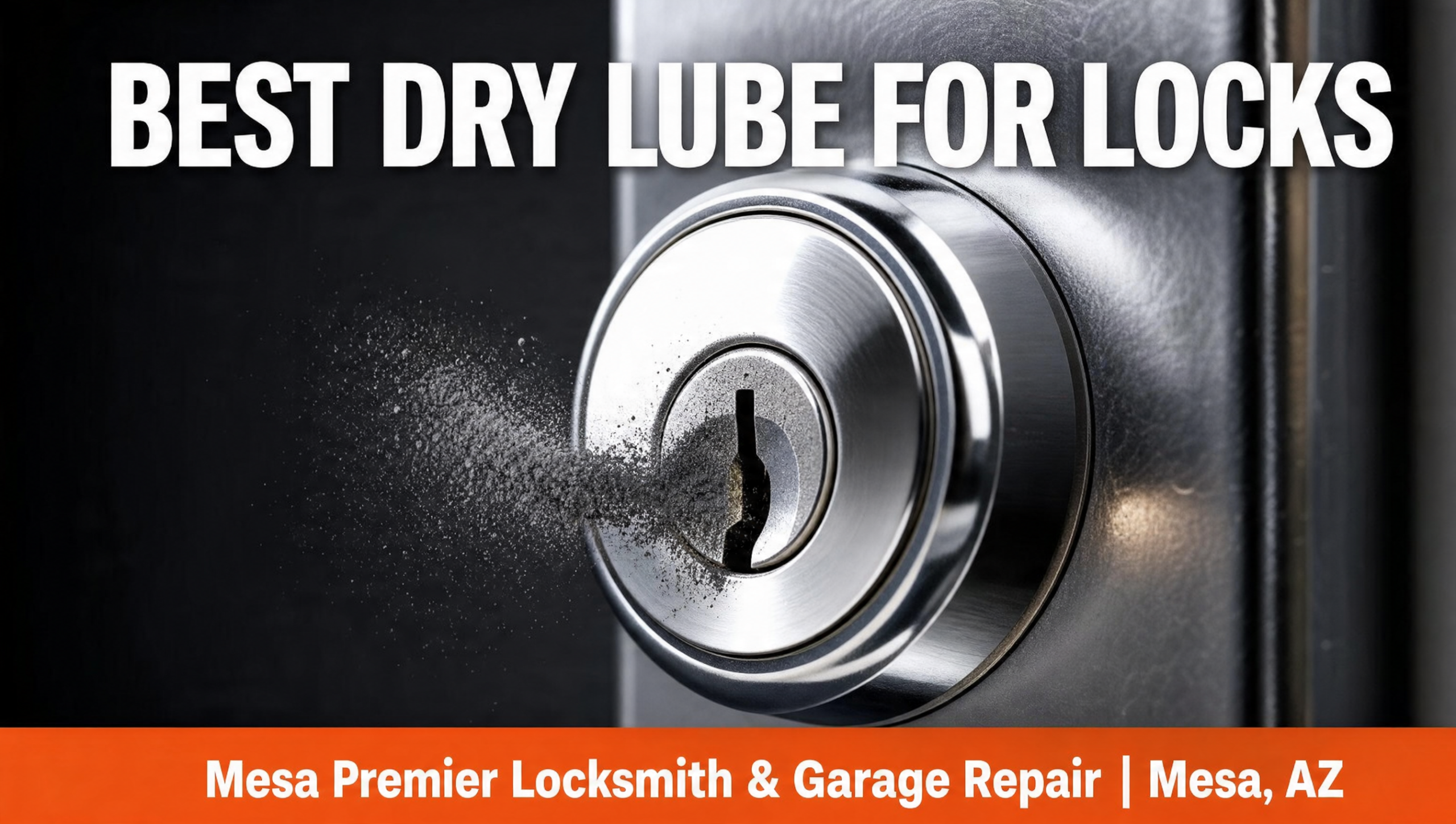
Using the wrong lubricant on a modern high-precision lock doesn’t just reduce performance — it permanently damages the internal mechanism. Graphite powder and PTFE (Teflon) spray are the industry-standard dry lubricants that protect pin stacks and cylinder tolerances without the residue buildup that oil-based products leave behind.
Every year, our technicians at Mesa Premier Locksmith & Garage Repair service dozens of locks that failed not because of a break-in or mechanical defect, but from a bottle of WD-40 applied by a well-meaning homeowner. Modern high-precision locks — particularly Grade 1 deadbolts, thumbturn locks, and keyless entry systems — operate within tolerances so tight that the wrong product clogs the cylinder and accelerates wear on every internal component. Keep reading to learn exactly what professional locksmiths use, why it works, and how to apply it the right way.
What Sets Modern High-Precision Locks Apart
Today’s residential and commercial locks are engineered to a fundamentally different standard than the hardware of a decade ago. Grade 1 deadbolt security hardware certified by ANSI/BHMA must pass 250,000 operational cycle tests — meaning the internal pin stack, springs, and cylinder must function flawlessly across a quarter million operations. To achieve that durability, manufacturers specify internal tolerances measured in thousandths of an inch.
Those tight tolerances are exactly why wet lubricants create problems. Oil-based products attract dust, pet hair, and airborne particulate. That debris mixes with the lubricant and slowly builds a gummy paste inside the cylinder. Over hundreds of cycles, that paste packs around the pin stack and spring system — creating the resistance homeowners describe as a “sticky” or “grinding” key turn.
Dry vs. Wet Lubricants — Lock Compatibility Guide
| Lubricant | Dry Formula | Lock Safe | Dust Attraction | Cold Performance | Verdict |
|---|---|---|---|---|---|
| Graphite Powder | ✓ Yes | ✓ Yes | Minimal | Excellent | ✓ Recommended |
| PTFE / Teflon Spray | ✓ Yes | ✓ Yes | Minimal | Excellent | ✓ Recommended |
| Silicone Spray | ✓ Yes | ✓ Yes | Moderate | Good | Acceptable |
| White Lithium Grease | ✗ No | Hinges only | Moderate | Moderate | Avoid on Cylinders |
| WD-40 (Standard) | ✗ No | ✗ No | Very High | Poor | ✗ Not Recommended |
| Petroleum Oil | ✗ No | ✗ No | Very High | Poor | ✗ Not Recommended |
Why the Best Dry Lube for Locks Outperforms Every Wet Alternative
Dry lubricants — graphite powder and PTFE (Teflon) spray being the most widely used — work differently than oil-based counterparts. They create a low-friction film directly on metal surfaces without leaving any liquid or semi-liquid residue. When debris enters the cylinder, it passes through rather than binding.
Graphite powder has been the go-to choice among professional locksmiths for generations. It’s chemically inert, it won’t freeze in cold temperatures, and it doesn’t react with the metal alloys used in modern lock cylinders. A small application puffed directly into the keyway, followed by several key insertion cycles, distributes the powder evenly through the full pin stack.
PTFE (Teflon) spray, sometimes marketed simply as “lock lubricant,” applies as a liquid that flashes off within seconds and leaves a dry, slippery film. Brands like 3-IN-ONE Lock Dry Lube and Houdini Lock Lube use PTFE as their active ingredient. These products are particularly effective on thumbturn locks and push-button mechanisms where distributing fine powder evenly is difficult.
Both options are appropriate for thumbturn locks, padlocks, mortise locks, deadbolts, and most electronic lock and smart lock hardware — making them the most versatile tools in any locksmith’s kit.
What to Avoid
The most common mistake we see at Mesa Premier is the application of penetrating sprays to a lock cylinder. Standard WD-40 is a water displacer, not a lubricant. It relieves short-term stiffness by displacing moisture, but the residue it leaves behind attracts dirt aggressively. Within weeks, a lock treated with WD-40 becomes stickier than before treatment. Petroleum jelly and standard machine oil share the same weakness: they trap debris, thicken at lower temperatures, and gradually degrade the internal seals found in electronic hardware.
Pro Tip — From Our Technicians: New locks sometimes feel stiff right out of the box. Manufacturers apply a light factory oil during assembly that accumulates dust during shipping and storage. Before calling for a service visit, apply a small amount of graphite powder and cycle the mechanism twenty to thirty times. Most new-lock stiffness resolves completely with that first proper break-in lubrication — no service call needed.
How to Apply Dry Lubricant to a Deadbolt or Thumbturn Lock
Proper application takes under five minutes and requires no tools beyond the lubricant and a key:
- Clear the keyway first. A few short bursts of compressed air remove accumulated debris before you introduce any lubricant.
- Apply graphite or PTFE to the keyway. For graphite, use the dispenser nozzle and deliver a small puff directly into the opening. For PTFE spray, a one-second burst is sufficient — avoid over-applying.
- Cycle the mechanism fully. Insert the key and work it in and out several times, then turn it through the complete operating range: locking and unlocking the deadbolt completely.
- Treat the bolt face. Apply a small amount of PTFE spray to the bolt face and the area where it contacts the strike plate.
- Test the thumbturn. Rotate it fully in both directions — it should move smoothly without unusual resistance.
If the lock remains stiff after correct application, the cylinder likely has significant internal buildup or worn components. Our residential locksmith team handles cylinder servicing and can often restore full function without replacing the entire hardware set. You can also review our post on winter lock maintenance for complementary seasonal care guidance.
Home Safety Starts with Hardware That Functions Correctly
A deadbolt that operates smoothly is a home safety issue, not just a comfort one. A stiff or poorly maintained lock takes longer to operate under pressure — which matters during an emergency exit situation. It also signals to any experienced locksmith that the hardware may be approaching the end of its service life.
If oil-based products have been used for years, the accumulated residue inside the cylinder will need to be professionally cleaned before dry lubricant can perform effectively. Our team at Mesa Premier Locksmith & Garage Repair provides thorough cylinder cleaning as part of our full lock tune-up service. For properties with older hardware, we may recommend a rekey or full replacement depending on the condition of the internal mechanism. For Mesa and East Valley homeowners evaluating a full security upgrade, smart lock installation eliminates the keyway maintenance issue entirely. Our commercial locksmith team handles multi-point access control systems with the same standards we apply to residential hardware.
Frequently Asked Questions
What is the best dry lube for locks?
Graphite powder and PTFE (Teflon) spray are the top choices recommended by professional locksmiths. Both create a low-friction, debris-repelling film inside the cylinder without leaving sticky residue. Graphite is ideal for pin tumbler deadbolts; PTFE spray works across all lock types including thumbturn mechanisms and electronic hardware.
Can I use WD-40 on my deadbolt?
WD-40 is a water displacer, not a lubricant — and using it on a lock is one of the most common mistakes we see in the field. It may relieve stiffness briefly by displacing moisture, but the oily residue it leaves attracts dust and debris aggressively. Within weeks, that residue builds up inside the cylinder and creates the grinding sensation that leads homeowners to believe their lock is defective.
How often should I lubricate my locks?
For most residential deadbolts and thumbturn locks, a single application of dry lubricant once every 12 months is sufficient under normal conditions. Exterior locks and padlocks exposed to direct weather may benefit from an additional application after periods of heavy rain or extreme heat. If a lock starts feeling stiff between scheduled maintenance, treat it promptly rather than waiting.
Is graphite powder safe for smart locks and electronic locks?
Graphite is safe for the mechanical cylinder components of smart locks, but keep it away from circuit boards, sensor areas, and keypad connections. For electronic hardware, a PTFE spray specifically labeled as electronics-safe is the better choice. When in doubt, consult the lock manufacturer’s maintenance guidelines or call a professional locksmith to service the hardware correctly.
How do I know if my lock needs professional cleaning rather than just lubrication?
If a lock remains stiff, grinds, or fails to operate smoothly after two correct applications of dry lubricant, the cylinder likely has significant buildup or worn internal components that lubrication alone won’t fix. A professional locksmith can disassemble the cylinder, flush out contaminated material, replace worn pins or springs, and reassemble the mechanism to spec — often saving you the cost of a full lock replacement.
Talk to a Mesa Premier Locksmith Before Your Next Maintenance Cycle
Knowing which product to use, how to apply it, and when a lock has crossed from “needs maintenance” to “needs replacement” takes hands-on experience with real hardware across hundreds of service calls. If you’re unsure about the condition of any lock on your property — deadbolts, thumbturn mechanisms, padlocks, or electronic hardware — connect with our team before a small issue becomes a bigger one.
Find us on Google Maps, reach out through our contact page, or call us directly for a home security assessment with a certified locksmith. At Mesa Premier Locksmith & Garage Repair, we proudly serve Mesa, AZ and the entire East Valley with residential and commercial locksmith services — and we’re always glad to walk any homeowner through the right approach to lock care before it becomes an emergency.