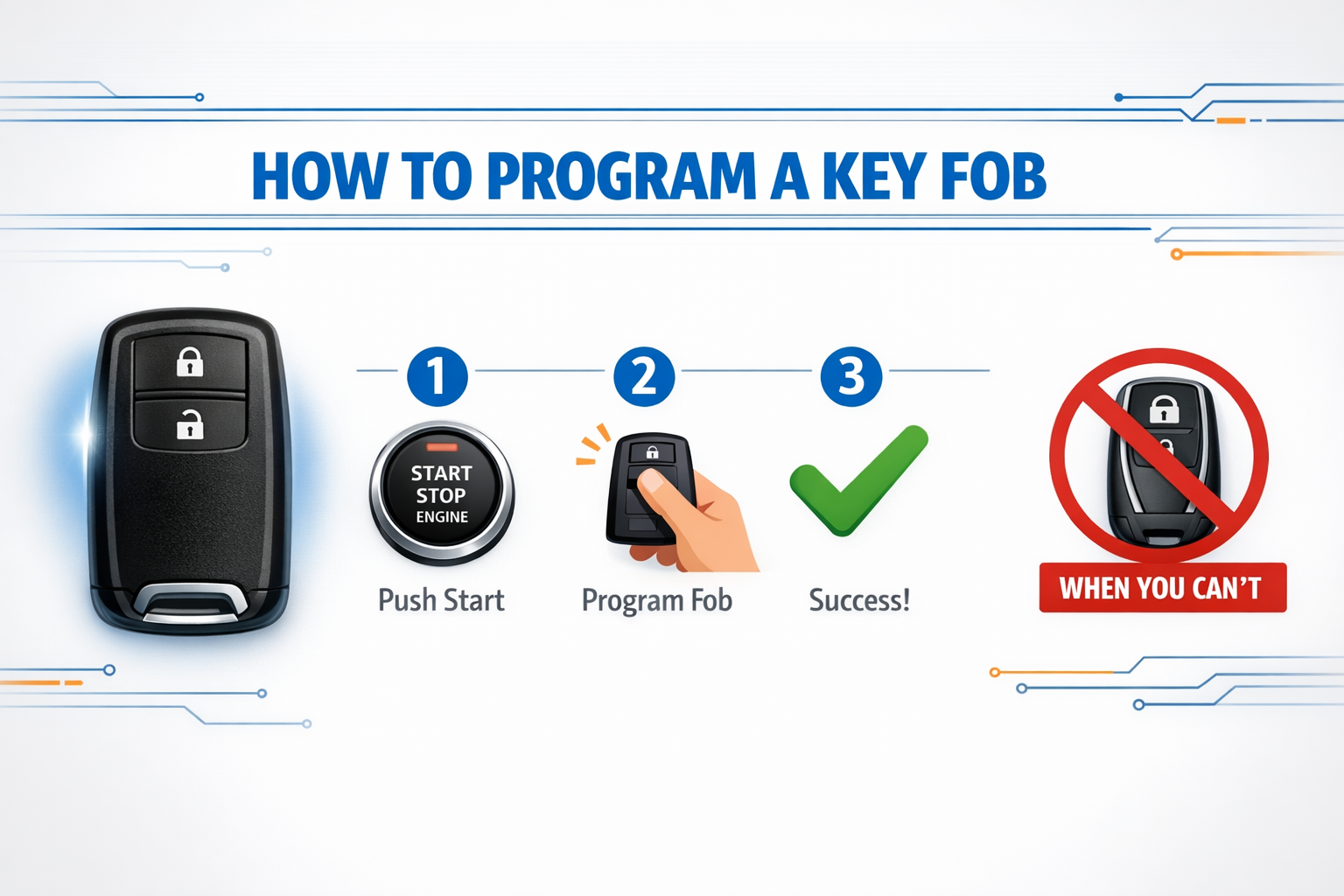
Some key fobs can be programmed in your driveway in under two minutes — and some will never respond to a home procedure no matter how many times you cycle the ignition. The difference comes down to how your vehicle’s security system authenticates a new remote, and knowing which category your car falls into saves you from a frustrating afternoon of failed attempts. This guide explains exactly how key fob programming works, walks through the on-board steps for vehicles that support them, and — just as importantly — tells you which fobs you genuinely cannot self-program. If you own a newer vehicle with push-to-start, the honest answer often ends with a call to a professional, and we cover why. Everything below reflects how our automotive team at Mesa Premier Locksmith & Garage Repair approaches these jobs every day in Mesa and across the East Valley.
How Key Fob Programming Works
Before you try any procedure, it helps to understand what “programming” actually does — because the word covers three different things that people constantly confuse.
A key fob is a small radio transmitter. When you press a button, it sends a coded signal to a receiver in your vehicle. Programming a fob means teaching that receiver to recognize and trust the specific code your fob transmits. Until that handshake is established, the vehicle simply ignores the signal.
There are three distinct systems at play, and the type your car uses determines whether home programming is even possible:
- Remote keyless entry (RKE) — the lock, unlock, and trunk buttons. This is the simplest layer and the one most likely to support an on-board (do-it-yourself) procedure on older vehicles.
- Transponder / immobilizer — a transponder chip key has a chip inside the head that must be authenticated before the engine will start. This layer is encrypted and usually requires diagnostic equipment.
- Proximity smart key (push-to-start) — a fob that unlocks the doors as you approach and starts the car with a button. These are almost always locked down to dealer or automotive locksmith tools.
The critical takeaway: a rolling-code security system means every modern fob transmits a code that changes with each use, synchronized to the vehicle. That is what stops a thief from recording your signal and replaying it — and it is also why “just pairing it” is not as simple as it was in the 1990s. On-board programming exists only where the manufacturer built a customer-accessible sequence into the car. Where they did not, the receiver will only accept a new fob through a secured diagnostic session. You can see the full range of what we handle on our locksmith services page.
Key Fob Programming: What You Can Do at Home vs. What Needs a Pro
| Fob / Situation | Home (On-Board) Programming | Needs a Professional |
|---|---|---|
| Older remote (pre-2010 GM/Ford/Chrysler) | Often possible via learn mode | Only if on-board fails |
| Lock/unlock buttons only | Possible on supported models | If no learn mode exists |
| Transponder (engine must start) | Rarely — needs equipment | Yes — OBD programming |
| Push-to-start / proximity smart key | No home procedure | Yes — required |
| 2018+ FCA Secure Gateway (Chrysler/Dodge/Jeep/Ram) | Blocked by gateway | Yes — credentialed tool |
| Newer Toyota/Lexus, VW MQB, BMW, Mercedes | No on-board mode | Yes — diagnostic access |
| All keys lost | Not possible | Yes — key code + enrollment |
| Brand-new blank key | Must be cut first | Cut + program on site |
DIY Programming Steps
If you drive an older vehicle — roughly pre-2010, and especially older GM, Ford, Chrysler, and some Toyota models — there is a real chance you can add or reprogram a basic remote yourself. On-board programming puts the vehicle into a temporary “learn mode” that accepts new fob codes without any external tool.
The exact sequence varies by make, model, and year, so your owner’s manual is the authority. But the general pattern looks like this:
- Gather every fob you want to keep. Most learn-mode procedures erase all previously stored remotes and re-enroll only the ones present during the session. If you program one fob and forget the second, the second stops working.
- Get in and close the doors. Sit in the driver’s seat with the doors shut. Have the key (or all keys) ready.
- Cycle the ignition rapidly. Insert the key and turn it from OFF to ON several times in quick succession — many vehicles require between three and eight cycles within about ten seconds. On some models you end on ON without starting the engine. A chime or a lock-cycle from the doors usually signals that the car has entered learn mode.
- Press a fob button. With the vehicle in learn mode, press LOCK (or the manufacturer-specified button) on the first fob. A door lock cycle or chime confirms the code was accepted.
- Repeat for each additional fob. Program every remote in the same session, one after another, before exiting.
- Exit learn mode. Turn the ignition to OFF or open a door, depending on the procedure. Then test every button on every fob.
A few realities worth knowing before you start:
- A remote and a transponder are not the same job. An on-board procedure may pair the lock/unlock buttons but do nothing for the immobilizer chip. If your car still will not start with a freshly “programmed” key, the transponder side has not been handled — and that side rarely has a home procedure.
- The fob battery matters. A weak battery causes intermittent pairing failures that look like a programming problem. Replace it first.
- A blank still needs to be cut. If you are adding a brand-new key rather than re-syncing one you own, the metal blade has to be cut to your vehicle — programming alone will not turn the ignition or fit the door. If the key turns hard or the cylinder feels stiff, that is a separate ignition lock cylinder repair issue.
If you run the sequence correctly and nothing happens, that is usually not a mistake on your part. It is a strong sign your vehicle simply does not support on-board programming — which brings us to the fobs you cannot do at home. And if the remote you are fighting with is actually for your garage, our garage door remote troubleshooting guide covers that separately.
Fobs You Cannot Self-Program
On-board programming has been quietly disappearing for over a decade. As theft techniques evolved, manufacturers closed the customer-accessible pathways and moved everything behind encrypted authentication. If your vehicle falls into any of the groups below, no amount of ignition-cycling will work — the procedure was never built in.
Push-to-start / proximity smart keys. Nearly every vehicle with a START button and passive entry requires professional equipment to add a fob. The proximity system is tied directly to the immobilizer, and enrolling a new smart key means writing to secured modules.
Encrypted immobilizer chips. Modern transponders using encrypted chip families (commonly referenced as ID46, ID48, and DST80) authenticate with the vehicle in a way that on-board mode cannot satisfy. These need diagnostic access through the OBD port.
Manufacturer platforms that dropped on-board mode. Industry sources consistently flag these as requiring dealer- or locksmith-grade tools:
- Toyota H-key and SmartKey systems (newer Toyota/Lexus proximity keys)
- Volkswagen MQB-based platforms (roughly 2012 and newer)
- Most BMW and Mercedes-Benz models since the mid-2000s
FCA Secure Gateway (SGW) vehicles. Many Chrysler, Dodge, Jeep, and Ram vehicles from 2018 onward added a Secure Gateway module that blocks any key programming unless the tool has registered, authenticated credentials. Even the correct diagnostic device has to pass through the gateway.
For all of these, “programming” happens over the OBD-II port — the same diagnostic port used for engine scans — with a tool that can negotiate the vehicle’s security protocol. That is not a home job, and it is not because you are doing anything wrong. It is the system working as designed. A qualified automotive locksmith carries the equipment to handle these on site, often without the wait or markup of a dealership.
Pro Tip — From Our Mesa Premier Technicians. Before you assume a fob is dead or unprogrammable, do two quick checks: swap in a fresh coin-cell battery, and confirm the fob is even the correct part number for your exact model and year. We regularly get calls about “broken” remotes that turn out to be the wrong fob variant purchased online, or a perfectly good remote with a flat battery. Two minutes of verification can save a service call — and when it genuinely needs equipment, we would rather tell you that up front.
Transponder & Push-to-Start
This is where most home attempts quietly fail, so it deserves its own explanation.
A transponder key contains a tiny microchip in the plastic head. When you turn the ignition, the vehicle’s immobilizer sends a radio pulse, the chip answers with an encrypted code, and only a matching answer allows the engine to start. Virtually every vehicle built after 1996 uses some form of this system. Cutting a key to the right shape gets it to turn — but if the transponder is not programmed to your immobilizer, the engine will not crank over, or it will start and immediately stall.
Push-to-start proximity fobs take this further. There is no blade to insert; the car detects the fob’s presence through the same encrypted immobilizer relationship and lets you start with a button. Because entry, ignition, and anti-theft are all bound together, adding one of these fobs means authenticating against the vehicle’s security modules — a process that has no customer-facing shortcut.
Here is the practical decision tree:
- Just need the lock/unlock buttons to work again on an older car? An on-board procedure might do it. Try the DIY steps above.
- Need the car to actually start with the key? That is the transponder side. On most vehicles this requires programming equipment.
- Have a push-to-start button and no blade? Plan on professional programming from the start — there is no home path.
A common and important note on transponder work: in most cases a locksmith can program a transponder key, and often faster and more affordably than a dealer. There are rare exceptions where dealer-only restrictions apply, but for the large majority of makes and models, a properly equipped automotive locksmith is the practical choice — and one who comes to you rather than requiring a tow. If a worn cylinder is making the key hard to turn, we also handle ignition cylinder repair on the same visit.
Frequently Asked Questions — Key Fob Programming
Can I program a key fob myself?
Sometimes. Many older vehicles — roughly pre-2010, and especially older GM, Ford, and Chrysler models — have a built-in on-board procedure that lets you pair the lock and unlock buttons by cycling the ignition and pressing a fob button. Most newer vehicles, and anything with push-to-start, do not have a home procedure and require professional programming equipment.
Why won’t my car start after I “programmed” the fob?
Because programming the remote buttons is a different job from programming the transponder chip. An on-board procedure may sync the lock/unlock functions but do nothing for the immobilizer. If the doors respond but the engine will not crank, the transponder side has not been programmed — and on most vehicles that step requires diagnostic equipment.
Do I need to program all my key fobs at the same time?
On many on-board procedures, yes. Learn mode often erases all previously stored remotes and re-enrolls only the fobs present during that session. If you have two fobs, program both in the same sitting — otherwise the one left out will stop working.
Can a locksmith program a transponder or push-to-start key?
In most cases, yes. A properly equipped automotive locksmith can cut and program transponder keys and proximity smart keys for the large majority of makes and models, usually faster and more affordably than a dealer — and on site. There are rare exceptions with dealer-only restrictions, but they are the exception, not the rule.
My fob still won’t pair after following the steps. What now?
First replace the fob battery and confirm the fob is the exact correct part number for your year, make, and model — wrong-variant fobs bought online are a common culprit. If the fob is correct, the battery is fresh, and the on-board sequence still does nothing, your vehicle most likely does not support home programming and needs a professional with OBD equipment.
How long does professional key fob programming take?
For most vehicles, a mobile locksmith can cut and program a new fob in well under an hour on site. All-keys-lost situations and secured-gateway vehicles can take longer because of the extra authentication steps, but they are still typically same-visit jobs.
When to See a Locksmith
There is a clear line between a job worth trying yourself and one that needs equipment. Call a professional when any of these is true:
- Your vehicle has push-to-start or passive proximity entry. These require diagnostic programming, full stop.
- You need the engine to start, not just the doors to lock — meaning the transponder must be programmed.
- You have lost every working key. All-keys-lost situations often require the vehicle’s key code and a secured session to generate and enroll a new key from scratch.
- You ran the on-board procedure correctly and nothing happened. That is the signal your vehicle does not support it.
- Your vehicle is 2018-or-newer FCA (Chrysler/Dodge/Jeep/Ram), a newer Toyota/Lexus, VW MQB, BMW, or Mercedes — the platforms that dropped customer programming.
- You bought a fob online and it will not pair — it may be the wrong variant, uncut, or require enrollment you cannot do at home.
Choosing a mobile automotive locksmith over a dealership usually means a faster turnaround, on-site service wherever your car is, and no tow bill. Our technicians cut keys to your vehicle, program transponders and proximity fobs, and handle all-keys-lost jobs — and if you are ever locked out in the process, our car lockout service covers that too.
Key fobs are one slice of vehicle and property security. The same precision applies whether we are programming a smart key, evaluating a worn ignition, or working on your home. On the residential locksmith side we handle smart lock installation, electronic lock installation, and rekey home locks service — and if you are stuck outside, our house lockout service gets you back in. For businesses, our commercial locksmith division covers access control and master key systems across the East Valley. Every call is handled by trained technicians who explain what they found before doing the work — you can read more about us and how we operate.
Get Your Key Fob Programmed Right the First Time
Programming a basic remote on an older vehicle is a fair DIY project — grab your owner’s manual, follow the on-board sequence, and test everything before you exit learn mode. But if you drive a newer car with push-to-start, an encrypted transponder, or a secured gateway, the smart move is to skip the guesswork. The equipment required is not something you can improvise, and repeated failed attempts will not change the outcome.
If you are not sure which category your vehicle falls into, tell us the year, make, and model and we will tell you honestly whether it is a home job or a service call. Find us on Google Maps or reach our Mesa, AZ team through our contact page. Mesa Premier Locksmith & Garage Repair programs fobs, cuts keys, and handles transponder and proximity work for drivers throughout Mesa and the East Valley — done right, on site, the first time.