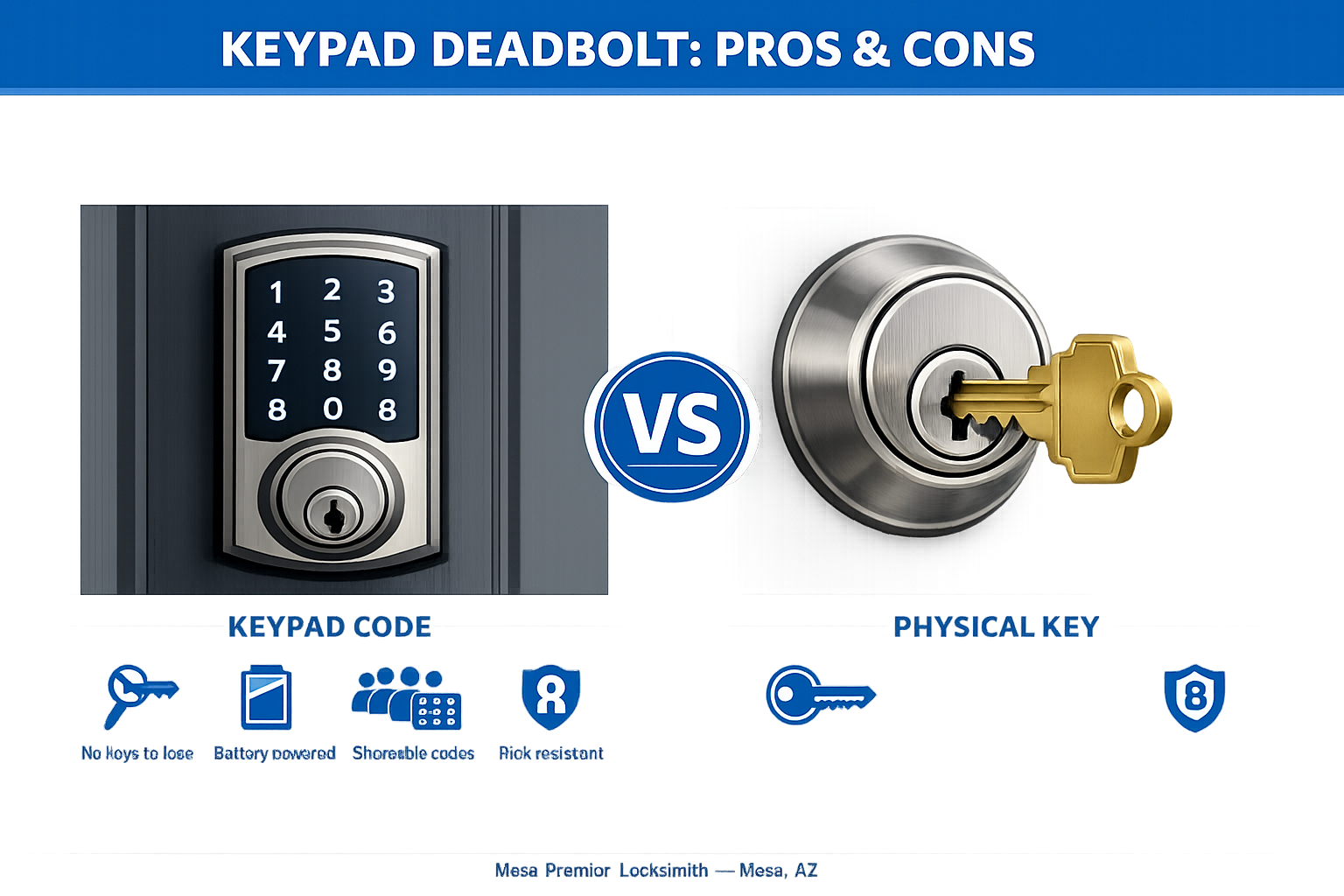
Keypad deadbolt pros and cons come up in nearly every front-door upgrade conversation we have across Mesa, and the honest answer surprises people. A keypad deadbolt erases the classic problems of a metal key — copies floating around, keys lost in a parking lot, hide-a-key spots under the mat. What it does not do is make your door automatically safer. Real security still lives in the grade of the bolt, the quality of the installation, and the habits behind the code.
At Mesa Premier Locksmith & Garage Repair, we install and service both keyed and keyless hardware on homes throughout Mesa and the wider East Valley, so we watch how each option performs in real desert conditions. This guide lays out the genuine keypad deadbolt pros and cons, explains how the lock actually works, and helps you decide what belongs on your door. Our residential locksmith technicians pulled these notes straight from years of field calls, not from a product brochure.
How a Keypad Deadbolt Actually Works
A keypad deadbolt swaps the key cylinder for a numeric pad, or sits alongside one. You press a code, the lock confirms it, and a metal bolt retracts from the door frame. The electronics handle authentication. The bolt itself handles security — and that distinction is the whole story.
There are two broad families. Mechanical pushbutton deadbolts run entirely on internal gears and springs, with no batteries and no electronics. Electronic and smart keypad deadbolts are battery powered and often add app control, auto-lock, entry logs, and connection to systems like smart lock installation ecosystems. Both still drive a true deadbolt into the strike — the same component that resists a shoulder or a pry bar on a standard keyed lock.
The table below compares the two approaches side by side so you can see where a code helps and where a key still earns its place. For homeowners weighing a full upgrade, our electronic lock installation team walks through these same trade-offs in person.
Keypad Deadbolt vs. Traditional Key Deadbolt
| Feature | Keypad Deadbolt | Traditional Key Deadbolt |
|---|---|---|
| Entry Method | Numeric code (optional key or app) | Cut metal key |
| Lost Credential | Change the code, no hardware swap | Rekey or replace the cylinder |
| Sharing Access | Unique code per person | Hand over a physical copy |
| Pick / Bump Resistance | No keyway on full-electronic models | Vulnerable on builder-grade cylinders |
| Power Source | Batteries (none on mechanical models) | None |
| Backup Entry | Spare key, app, or override (model dependent) | Spare key only |
| Changing Access | Reprogram on the spot | Cut new keys, rekey cylinder |
| Desert Heat Exposure | Electronics need shade and battery checks | Unaffected by heat |
| Best Use For | Busy households, rentals, frequent guests | Simple single-user doors |
| Top Security Grade | ANSI/BHMA Grade 1 available | ANSI/BHMA Grade 1 available |
Keypad Deadbolt Pros and Cons: The Honest Breakdown
The keypad deadbolt pros and cons split fairly cleanly into convenience gains on one side and maintenance and discipline on the other. Here is how our techs frame it for Mesa homeowners.
The Pros of Going Keyless
- No physical key to copy, lose, or hand out. A code cannot be cut at a hardware store counter or left in a coat pocket. That alone removes the most common way spare keys end up in the wrong hands.
- A unique code for every person. Family, house cleaners, dog walkers, and contractors can each receive their own code, and you can remove any one of them without touching the hardware. When a roommate moves out, you change the code instead of calling us to rekey your locks.
- A harder target for picking and bumping. Full-electronic models have no exposed keyway, so the lock-picking and bump-key methods that defeat builder-grade cylinders simply have nothing to work on.
- An entry record on smart models. Many electronic deadbolts log each code and time, which is genuinely useful for households with kids or rotating service visits.
- The end of the hidden spare. Once a code lives in your head, the rock by the porch and the magnetic box under the bumper retire for good — and those hiding spots are the first places an intruder checks.
The Cons Worth Knowing
- Batteries are a maintenance item. Electronic models run on batteries that drain over time, and Mesa’s heat shortens battery life on sun-exposed doors. A keyed deadbolt never asks for a battery.
- Codes can be watched or overshared. A code given out too freely, or typed in plain view of the street, loses its advantage. Shoulder-surfing is real.
- Wear can betray a code. On units used for years, the four most-pressed buttons can develop visible wear, narrowing the guesswork for anyone paying attention. Rotating the code occasionally solves this.
- Security tracks the grade, not the keypad. A bargain unit with a Grade 3 bolt is not secure just because it is keyless. The bolt grade is what stops a kick-in.
- More components that can need service. Electronics, motors, and pads add parts that can fail, which is why a backup entry plan matters. If a lock ever locks you out, our house lockout service covers exactly that situation.
Is a Physical Code Safer Than a Key?
This is the question behind the search, so we will answer it directly: a code is safer than a key against some threats and weaker against others. The right setup depends on which risks apply to your home.
A traditional key is vulnerable in ways most people underestimate. Keys are copied at any hardware counter, sometimes without the owner ever knowing. Bump keys and basic pick sets defeat low-grade cylinders in the hands of someone who has practiced. And a lost key has no off switch — until you rekey, that key opens your door. When that happens, our residential lockout specialist can restore access and rekey on the same visit.
A code closes those doors. There is nothing physical to copy, nothing to pick on a full-electronic model, and a compromised code is retired in seconds. The trade is that codes face human weaknesses instead of mechanical ones — guessable numbers like a street address or a birth year, codes shared past their welcome, and digits learned by watching.
Here is the field-tested verdict: a Grade 1 keypad deadbolt, installed correctly and paired with sensible code habits, closes more of the everyday attack paths than a builder-grade keyed lock on the same door. A high-security keyed deadbolt with a restricted, patent-protected keyway is also a strong choice. The strongest residential setups we install often pair a certified deadbolt with keyless entry, and our residential security team sizes that combination to the door. For the grading itself, the standards are published by the American National Standards Institute (ANSI/BHMA), which rates hardware Grade 1 through Grade 3 for residential strength.
Mechanical vs. Electronic Keypad Deadbolts in the Mesa Climate
Choosing between the two keypad families is really a question about your door, your household, and how much desert sun that entry takes.
Mechanical Pushbutton Deadbolts
A mechanical pushbutton deadbolt uses no batteries and no electronics, which makes it well suited to gates, casitas, pool houses, and side entries that bake in direct Arizona sun. It typically holds a single code and has no app, no log, and no auto-lock. For a low-traffic door that you simply want to open without carrying a key, it is a clean, low-maintenance answer that shrugs off heat.
Electronic and Smart Keypad Deadbolts
Electronic models bring the features most homeowners picture: multiple codes, entry logs, auto-lock, and app or voice control. Platforms such as Apple HomeKey locks push that even further, letting an iPhone or Apple Watch open the door with a tap while a real deadbolt stays behind the electronics. The trade-off in Mesa is heat. South- and west-facing doors can pass 110°F at the surface in summer, and that thermal load shortens battery life and stresses electronics. We point homeowners toward hardware rated for outdoor temperature swings, and we often suggest a storm door or a shaded entry to protect the unit. The same logic applies to businesses — our commercial locksmith crew specs heat-tolerant access hardware for storefronts and offices across the valley, and broader smart lock options when an entire access system is on the table.
Installation, Maintenance, and When to Call a Pro
A keypad deadbolt is only as strong as the install behind it, and this is where experience separates a secure door from a false sense of security. Our technicians have prepped and hung locks on every door type common to Mesa homes — solid core, hollow metal, and the heavy front doors that come with newer East Valley builds. You can read more about our background and training on our about us page.
A correct installation starts with the bolt throw and the strike. We recommend ANSI/BHMA Grade 1 hardware for primary entries, a reinforced strike plate, and three-inch screws that bite into the framing stud rather than the jamb alone — the single biggest factor in kick-in resistance. We confirm the bore alignment and bolt travel so the lock seats fully every time, because a deadbolt that does not fully extend offers a fraction of its rated protection. For doors that need the cylinder reworked rather than replaced, our electronic lock installation and rekey work keeps the existing setup running.
Maintenance is light but real. Keep the keypad clean so wear stays even, cycle the bolt with a quality dry lubricant a couple of times a year, and swap batteries before they fully drain rather than after. Our guide to the best dry lube for locks covers what to use and what to avoid, and our broader lock maintenance routine keeps every entry point on the property moving smoothly. Test your backup key or override path on a calm afternoon, not during a lockout. If you ever do get locked out, both our home and rekey services are a call away.
Some jobs belong with a pro from the start: a bolt that no longer aligns after the door frame has settled, a retrofit onto a non-standard door, or any multi-unit and access-control project. Homeowners can reach our residential locksmith team directly, and you can always find us on Google Maps to confirm we serve your neighborhood.
Frequently Asked Questions
Are keypad deadbolts safer than a traditional key?
They are safer against copied keys, lost keys, picking, and bumping, because a full-electronic model has no keyway to attack and a compromised code is changed in seconds. They face human risks instead — guessable codes and oversharing. A Grade 1 keypad deadbolt installed correctly and paired with good code habits closes more everyday attack paths than a builder-grade keyed lock.
What are the main keypad deadbolt pros and cons?
The pros: no physical key to copy or lose, a unique code for each person, no exposed keyway to pick, and entry logs on smart models. The cons: electronic models need battery upkeep, codes can be watched or overshared, heavily used buttons can show wear, and security still depends on the bolt grade rather than the keypad itself.
Do keypad deadbolts work during a power outage?
Yes. Electronic keypad deadbolts run on their own batteries inside the lock, not on household power, so a blackout does not lock you out. Many models also keep a backup keyway or an external terminal you can energize. Mechanical pushbutton deadbolts use no electricity at all and work regardless of power.
Can someone guess or hack my keypad code?
It is far less likely when you skip obvious numbers like a street address or birth year, avoid typing the code in plain view, and rotate it now and then so worn buttons do not reveal the digits. Quality electronic models also lock out repeated wrong attempts. Treat the code like a password and the keypad stays strong.
Mechanical or electronic keypad deadbolt — which is better for a Mesa home?
A mechanical pushbutton deadbolt needs no batteries and shrugs off direct desert sun, which suits gates, casitas, and sun-baked side doors. An electronic model adds multiple codes, logs, and app control for busy main entries. On south- and west-facing doors that pass 110°F, we steer homeowners toward heat-rated hardware and a shaded or storm-door setup.
Can a locksmith install a keypad deadbolt on my existing door?
In most cases, yes. Standard doors use a common bore size that fits the majority of keypad deadbolts, and our technicians confirm the fit, reinforce the strike, and align the bolt during installation. Non-standard or heavily settled doors may need extra prep, which is exactly the kind of work our residential team handles across Mesa and the East Valley.
Making the Right Call for Your Mesa Front Door
So where does that leave the keypad deadbolt pros and cons debate for your home? A code is not a magic upgrade and a key is not obsolete — the right answer depends on your door, your household, and how the hardware is installed and maintained. A busy home with kids, guests, and service visits usually benefits from keyless control and per-person codes. A quiet single-user side door may be perfectly served by a certified keyed deadbolt. Many of our clients land somewhere in between, pairing a Grade 1 bolt with keyless entry and a backup key tucked safely away.
If you are still torn between a code and a key, our recent breakdown of Apple HomeKey locks is a good next read, since it shows how today’s smart deadbolts keep a real mechanical bolt under the electronics. And when you are ready to put hardware on the door, the team at Mesa Premier Locksmith & Garage Repair is here to help you choose, install, and dial in the right deadbolt for your entry.
Reach our technicians through our contact page to set up an on-site assessment, ask us about smart lock installation for your specific door, or stop by our Google Maps listing to leave a review and see why Mesa homeowners trust us with their front doors. Your entry deserves hardware that fits how you actually live — let us help you get it right.