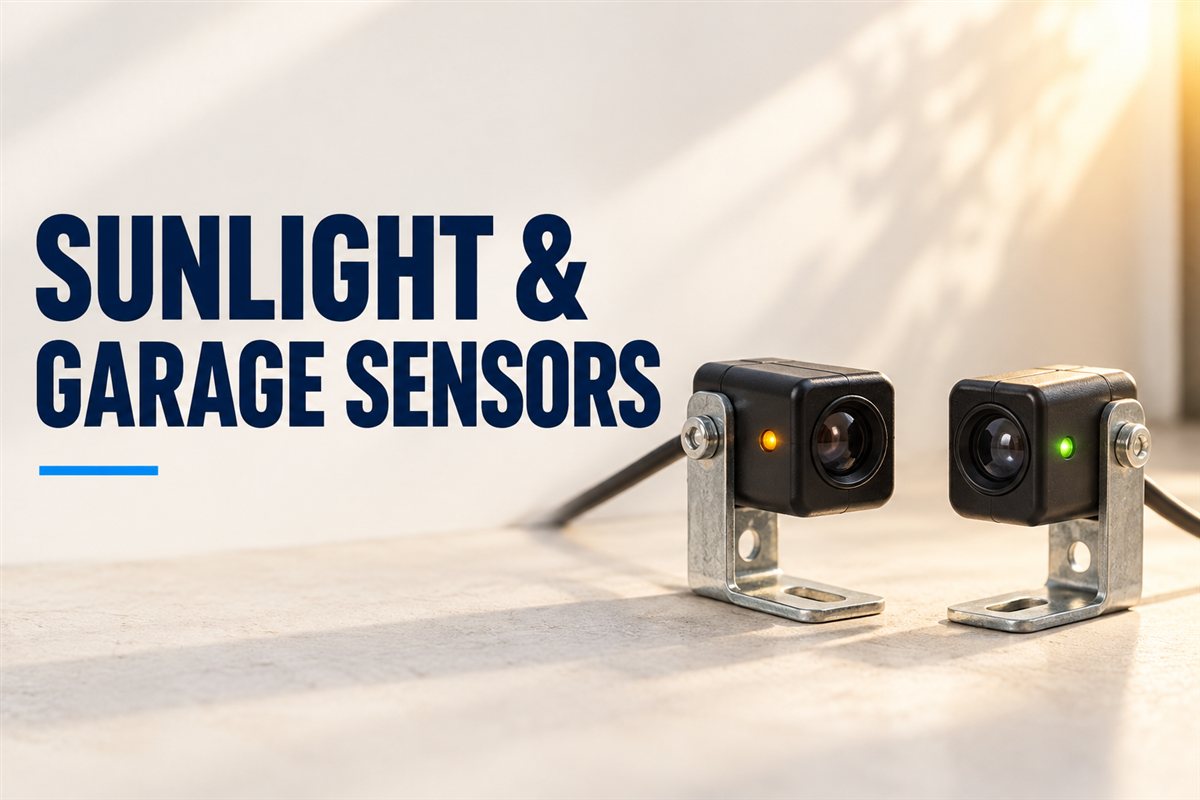
If your garage door won’t close in sunlight, direct light reaching a safety sensor may be interfering with its signal. A time-of-day pattern is a useful clue, but misalignment, dirt, wiring, and mechanical faults can produce similar symptoms. Keep the opening clear, record the conditions, and arrange diagnosis without bypassing the sensors.
Why a Garage Door Won’t Close in Sunlight
Photoelectric safety sensors monitor a beam across the garage opening. The receiving sensor must recognize the signal from its partner before the opener can complete normal closing. Direct sunlight can interfere with that process on some systems, making the opener respond as though the beam is obstructed.
Chamberlain Group’s sunlight interference guidance explains this condition and discusses model-specific remedies. It does not mean every door that refuses to close has a sunlight problem. The manufacturer, sensor type, installation, and exposure all matter.
For a Mesa homeowner, the most useful detail is the actual pattern: the door behaves normally at one time, refuses to close when sunlight reaches a particular sensor, and works again after the light angle changes. Share that observation with the service provider instead of assuming the remote or opener must be replaced.
Separate Sunlight Interference from Other Faults
Start with what happens during an ordinary closing attempt. Does the opener receive the command? Does the door move briefly and reverse? Is a sensor indicator off or flickering? Does the problem continue after sunset? Stop repeated attempts if the door is unstable, off its track, binding, or showing damaged cables.
| Observation | What it may suggest | Useful information to record |
|---|---|---|
| Failure occurs when sun reaches one sensor | Possible receiver interference | Time, exposure, and the indicator’s behavior |
| Closing fails throughout the day | Alignment, obstruction, wiring, or another fault | Whether both indicators remain steady |
| Sensor indicator changes when the door moves | Possible movement, alignment, or connection issue | When the change happens without touching wiring |
| Remote does not command opening either | A separate control, power, or opener issue | Which controls respond during normal operation |
| Door is crooked, scraping, or has a damaged cable | Mechanical fault requiring professional inspection | Visible damage; stop further operation |
These are clues, not remote diagnoses. More than one problem can be present. Sunlight might expose a marginal installation while a loose bracket or damaged connection causes intermittent operation at other times.
If the opener does not respond to the remote at all, the separate garage door remote troubleshooting guide addresses that control-related question. This article focuses on closing behavior linked to sensor exposure, rather than repeating remote programming instructions.
What to Observe Safely Before Calling
Only make observations from a safe position, with people and pets clear of the opening. Do not stand beneath the door, reach into moving hardware, or use your body to interrupt the beam. If anything appears mechanically damaged, stop using the system and request service.
- Note the opener’s make and model from an accessible label or your manual.
- Record the affected time window and whether sunlight reaches a sensor lens.
- Write down visible indicator colors and whether they are steady, flickering, or off.
- Check from a safe position for ordinary objects blocking the opening.
- Look for obvious debris on a lens or a bracket that appears displaced.
- Describe any recent impact, renovation, wiring work, or sensor replacement.
Use the specific owner’s manual for any permitted cleaning or routine owner maintenance. Do not apply solvents, spray lubricant onto lenses, open electrical covers, or disconnect wiring as part of a casual check. An indicator light alone does not prove that every safety function works.
Sensor Colors and Error Messages Are Model-Specific
Chamberlain Group’s sensor identification guide describes sending and receiving sensors and their indicators for its systems. Other manufacturers or sensor versions can use different designs. Identify your model before applying an interpretation from an online image.
Send the provider the exact message or flash pattern, along with the manual’s description if available. Avoid reporting only that the light is green or blinking. The side of the opening, sensor type, and operating conditions make that observation much more useful.
A phone photo taken from a safe location can show exposure and visible indicators, but it is not a substitute for inspecting alignment, connections, and door operation. Keep the image focused on the equipment rather than private home-security details.
Why Improvised Sensor Workarounds Are the Wrong Repair
The sensors are part of the system’s safety protection. Do not tape over a lens, relocate sensors above their prescribed position, put them together away from the opening, or use an override as the routine response to a closing failure. Those approaches can defeat the protection rather than fix the cause.
Manufacturer-approved shields or other approved installation changes may be appropriate for some equipment. A technician should first confirm the model, diagnose the fault, and select a remedy that preserves the monitored beam and specified mounting arrangement. A shade that blocks the partner sensor’s signal creates another obstruction.
Do not increase closing force to compensate for a suspected sensor problem. The sensor circuit and a mechanical binding problem need different diagnosis. For broader context on mechanical symptoms, see the existing guide to garage door problems in Mesa.
Plan the Inspection Around the Actual Conditions
Mesa Premier’s garage repair services include opener repair and maintenance. Describe the sunlight pattern when asking whether the team can inspect your specific equipment. If the fault occurs during a short time window, tell the scheduler so the inspection can be planned with that information.
Ask what the diagnostic visit includes, which repairs require separate approval, and whether any parts depend on the model. Do not assume a replacement sensor is necessary before alignment, exposure, and connections have been assessed. Confirm the quote and the proposed work before proceeding.
After a remedy is installed, request normal-operation and safety verification according to the equipment’s instructions. Chamberlain Group’s Protector System test guidance calls for professional service if its safety system does not respond as specified. If protection is suspected to be failing, stop using the opener and contact a trained professional.
Ask how to report a recurrence and whether the same sun exposure should be observed again. A door closing once in different lighting does not establish that the original intermittent fault is resolved.
Frequently Asked Questions
Can sunlight really stop a garage door from closing?Yes, some safety-sensor systems can experience interference when direct sunlight reaches the receiver. The opener may interpret the missing or disrupted signal as an obstruction. The time pattern can support the diagnosis, but the technician must also consider alignment, contamination, wiring, and the exact equipment before choosing a remedy. |
Why does the door open normally but refuse to close?Opening and closing do not necessarily use the safety-sensor signal in the same way. A closing failure can therefore occur while normal opening still works. Report both behaviors to the provider. Do not conclude that the opener is fully functional or the remote is faulty from that observation alone. |
Does an afternoon problem prove sunlight is the cause?No. A recurring afternoon pattern is useful evidence, especially if light reaches the receiver, but it does not rule out other faults. Record the timing and indicator behavior without moving the equipment. The inspection should distinguish exposure-related interference from connections, alignment, or mechanical changes that can occur at similar times. |
Should I cover the sensor with tape or cardboard?Do not cover the lens or improvise a device that can obstruct the monitored beam. Ask whether the manufacturer offers an approved shield for your model and whether it suits the installation. Any remedy must preserve sensor operation and the required positioning instead of creating a permanent bypass. |
Will replacing the remote battery solve this issue?A weak remote battery can cause separate control problems, but it does not remove sunlight reaching a safety sensor. Describe whether the opener receives commands and whether the door opens normally. Avoid buying a remote or reprogramming controls solely because the door refuses to close at a particular time. |
Can I use sensor lights to identify the receiving side?Consult the manual for your exact opener and sensor version. Some Chamberlain Group systems use specific indicator colors to distinguish sending and receiving units, but that convention is not universal. Record the observed colors and model details rather than applying a rule from an unrelated product photo. |
Do the sensors need replacement if a light flickers?Flickering can have several causes, including alignment, exposure, or a connection problem. It does not establish that a sensor has failed. Tell the provider when the indicator changes and whether sunlight is present. Replacement should follow diagnosis and compatibility checks, rather than being the automatic response to a light pattern. |
What if the door still fails to close after sunset?That observation weakens a simple sunlight-only explanation and makes other causes important to investigate. Report the continued failure, any error message, and visible sensor behavior. Keep people clear of the opening and stop using the system if you see damage or suspect a safety function is not working. |
Should I book service during the sunlight problem?Tell the scheduler when the problem typically occurs and ask whether that timing can be considered. An intermittent fault may be easier to assess under the conditions that trigger it, but appointment availability varies. Photos and a brief observation log can still help the provider prepare without promising an immediate diagnosis. |
How do I know the repair preserved sensor protection?Ask the technician to explain and verify the applicable safety functions using the manufacturer’s instructions. Keep the service record and any follow-up advice. If the door behaves unexpectedly or protection appears ineffective afterward, stop using the opener and request professional assistance rather than treating successful closing as proof of complete safety. |
Final Thoughts
If your garage door won’t close in sunlight, document the exposure pattern and arrange a model-specific inspection. Preserve the safety sensors, avoid improvised overrides, and confirm both normal closing and the required protective functions after any repair.
For garage door concerns in Mesa, call (480) 764-2839 or contact Mesa Premier Locksmith & Garage Repair. Share the opener model, time of day, and observed symptoms so the team can confirm service options and provide a quote.